Accurately targeting your logo to increase sales
Connect with more of the right people and incentivise them to choose you over your competition
Help shoppers recognize you as the right choice, with a logo that accurately conveys your suitability
Define key characteristics of your product or service to accurately direct your logo design
Connect with more eligible customers and incentivise them to choose you over your competition
Many businesses spend time and money convincing people to consider their industry, rather than target the shoppers who are already in your market, and help them choose you over your competition.
This second, simpler path not only focuses your valuable resources more effectively, it helps inform your logo design to be more influential.
A broad summary of a shopper’s decision-making process is:
Experience a problem and prioritize solving it
Research what product or service will solve it
Research providers of that product/service
Evaluate options against their own priorities
Choose the option whose characteristics best match their priorities
While your logo should represent your industry enough to qualify for step 3, clearly conveying how you qualify for steps 4 and 5 helps ensure more shoppers become your customers.
Help customers recognize you as a good choice, with a logo that accurately portrays your business
There are many characteristics you can focus on to connect with your ideal customer, but a good approach is from general to specific.
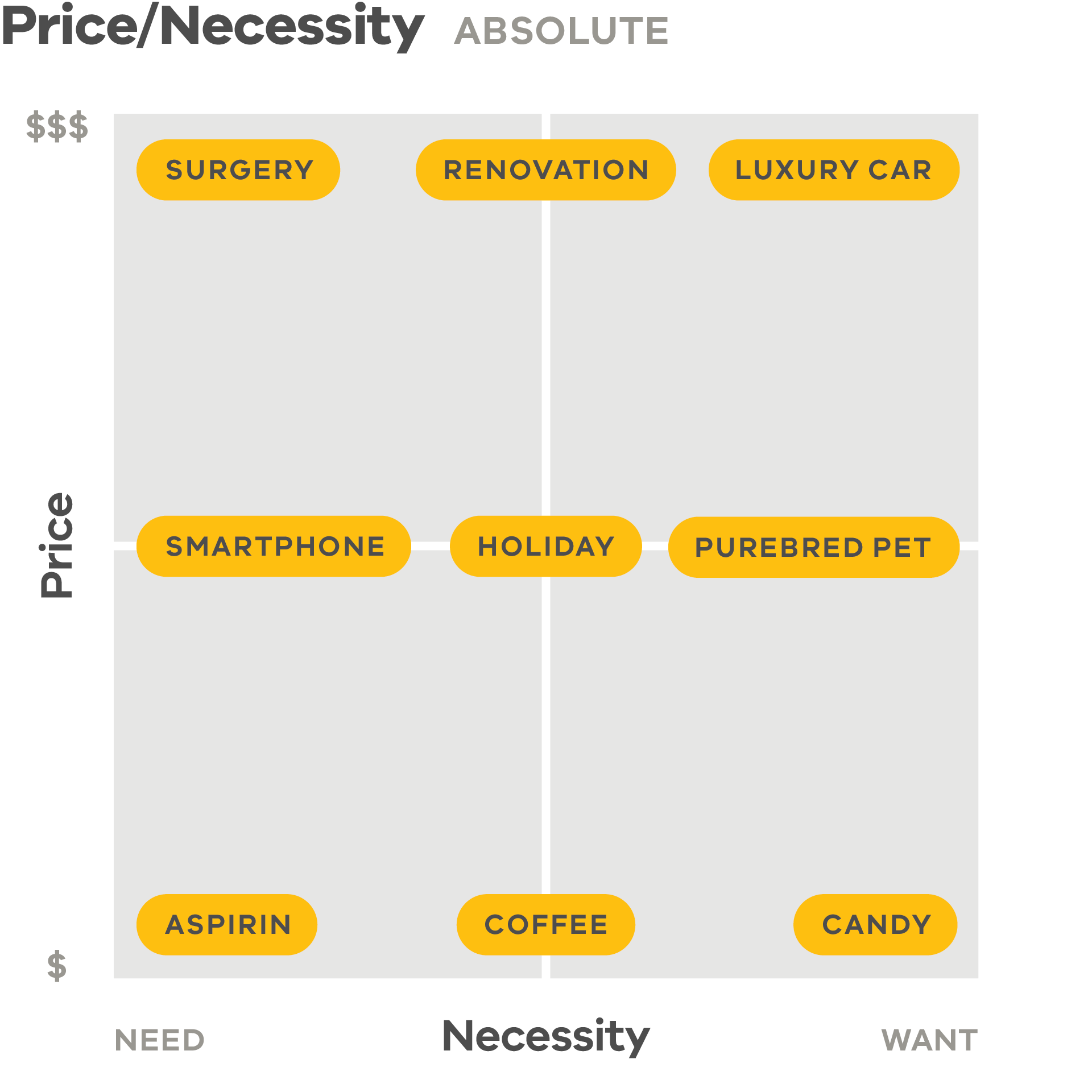
In addition to appearing representative of your industry, two general characteristics that work across every industry and are relevant to every shopper are: Price and Necessity. Conveying where you sit on these two characteristics will helpfully refine shoppers to those seeking what you offer, and are simple to convey visually.
For instance, a logo that looks like it’s for something expensive will remain in contention with shoppers for a premium item longer. Premium items are purchased less often, and shoppers typically take more time and decision steps to purchase.
Bargain shoppers will move on to the items that visually convey accessibility and value with a more day-to-day looking logo. For example, commodified items such as groceries, household goods and fuel are often evaluated once and replenished regularly, with little thought beyond a cursory comparison of retailers’ prices.
While price is a simple qualifier, the necessity of the purchase also plays a role.
We often think of expensive items as being more discretionary – more of a want than a need – but examples of necessary expensive items abound: medical procedures, sophisticated equipment, and insurance policies are examples.
Similarly, while day-to-day necessities come to mind as cheaper items, commodified indulgences such as confectionary, alcohol, and dining out are reasonably accessible and incur other considerations than cost.
To connect with more shoppers seeking what you offer, think about the nature of your product or service.
To illustrate the Price/Necessity dynamic, a luxury car is a great example of an expensive and discretionary purchase; while the necessity of transportation could be satisfied with a cheaper option, the shopper is opting to spend more on a more comfortable, higher status vehicle.
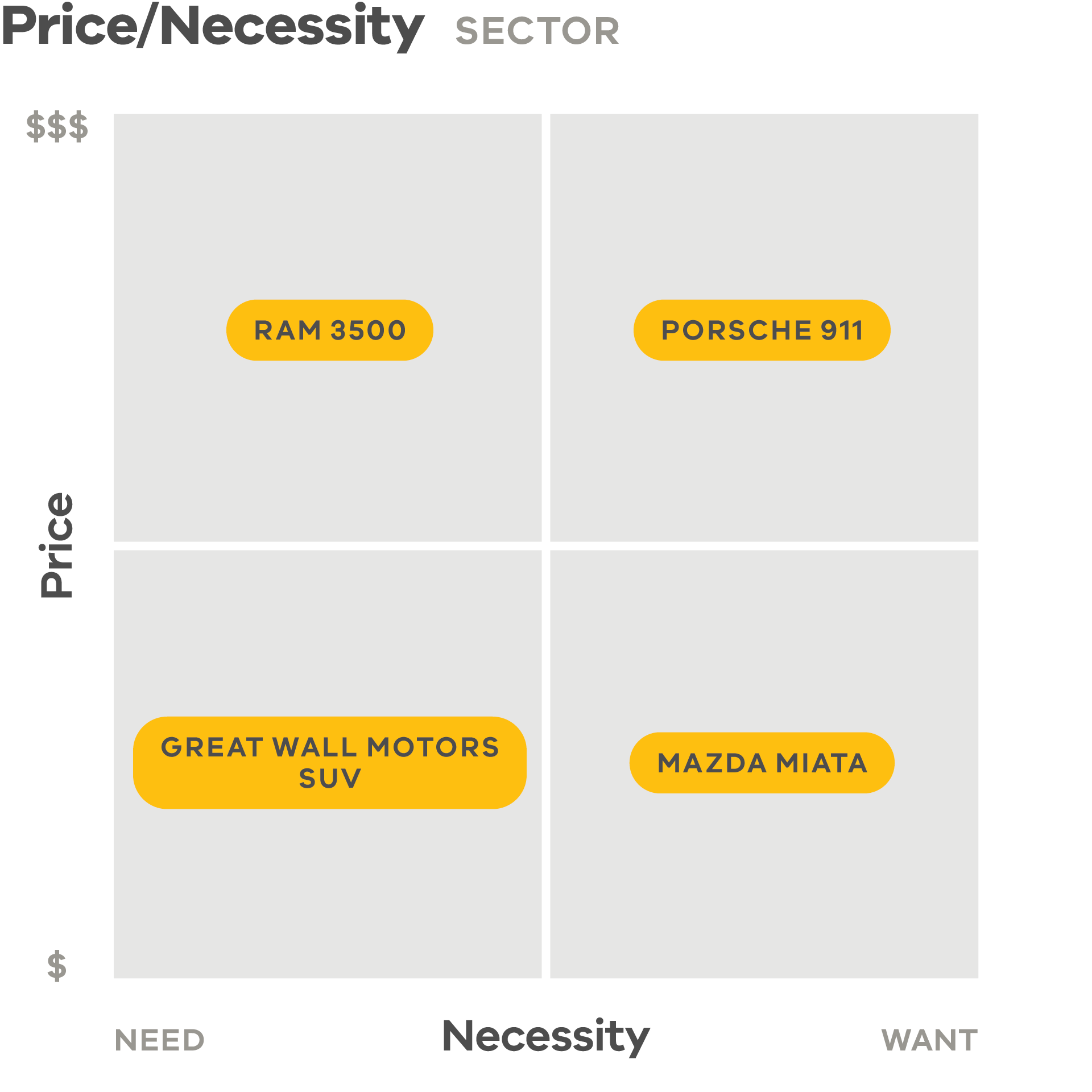
Because your logo will be most valuable helping shoppers decide on you over your competitors, Price/Necessity can help you see where you sit against those competitors. In this example focusing on vehicles, a Porsche 911 illustrates an expensive, discretionary option, while an emerging Chinese brand SUV offers significant utility for far less money. A Mazda Miata is an example of an indulgent-yet-accessible purchase (practicality, rather than cost, is its main consideration), while a Ram 3500 – with its massive towing capacity – illustrates meeting practical needs that incur signifiant expense.
Now let’s focus Price/Necessity on you and competitors selling the same product or service.
From gyms to electricians to accountants, medical clinics and solicitors, the service itself can be indistinguishable between competitors. But to distinguish themselves, some will promote on an aspect of their service as an advantage. For example: price; availability and responsiveness; or quality and expertise.
Charging more for the perception of higher quality service would place a provider in the premium top-right square. Charging time-restricted customers more for faster service would qualify for high-need/high-expense in the top-left. Discretionary services at an accessible price would appear bottom right. And an open-24-hours, walk-in, generalist service would be offering base necessity at a budget price, or bottom-left.
Given each of these providers offer a distinct take on the same service, it’s important that their logo accurately convey their distinct characteristic at a glance, so that they each connect with their relevant shoppers immediately.
While there are many more business characteristics that we can examine to connect more directly with those shoppers seeking them, Price/Necessity characteristics are effective for many reasons.
They’re universal and effective. Price and necessity are relevant to every shopper and all products and services. They can help focus your time and effort significantly.
They’re a good start. It’s to easier to try, evaluate and tweak when the factors are simple and there’s less of them.
More focus means more exclusion. Every additional criteria not only helps target one type of shopper, it can signal irrelevance to many others. Calibrating the right balance of targeting and exclusion will take time and experimentation.
Actions
Achieve results from this content by taking these three actions, referring back to the article as you go
Think of your business’ take on your product/service that distinguishes you from your competitors; your advantage
Chart your price and necessity, relative to your competition, to understand how you should portray yourself to shoppers
Update your logo and marketing materials to accurately reflect your advantage and connect with the shoppers who are seeking it