The three criteria for effective creative: business, technology, and taste
Creativity sets your communication apart by grabbing more attention and earning more opportunity to convince
Creativity developed without objectives and parameters isn’t effective communication, it’s art
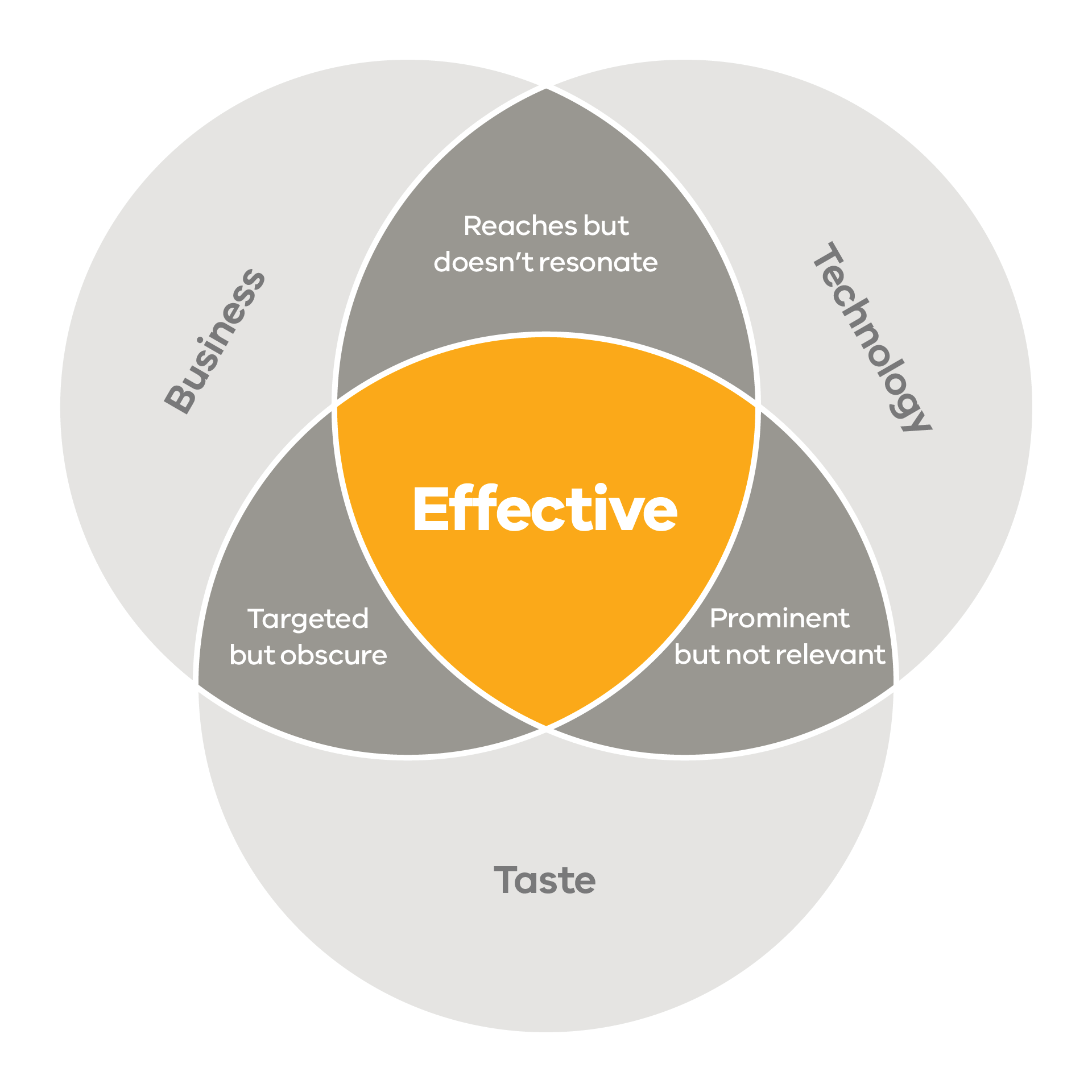
Ensure your creative meets business, technology, and taste criteria to be effective
Business
Relevance
Who to target and which of their priorities to focus on. Objectives and parameters of the communication exercise, such as the subject, target audience, and relevant characteristics of each.
Technology
Reach
How to reach your target audience. Physical or digital delivery medium and the context of the audience experiencing it will have a bearing on the effectiveness of your communication.
Taste
Resonance
How to get their attention. Creative direction, such as style and content of copywriting, visuals, and sound, to resonate with your target audience in that context.
A strategic approach to communication needs a strategy, and ensuring your strategy covers these three considerations means less reacting to surprise questions during implementation.
Like all requirements, conflicts will arise between them, so prepare to prioritize one over another to pursue an opportunity or avoid risks or costs.
There’s also plenty of wildly successful creative communication that didn’t cover each of these areas, even just shot from the hip. These aren’t laws of physics, after all, rather an insight into the type of decisions you’ll likely be asked to make, and how to prepare for them up front.
Speaking of those wildly successful examples, beware the case studies that perform a sort of phrenology on them and recommend you copy one key characteristic to replicate its success. As you’ll read below, what’s apparent to audiences is often the product of first principle decisions made in a strategy not unlike this format, and difficult to reverse-engineer accurately. Beware also of falling for cognitive survivorship bias, where some apparent characteristic of a successful example is lauded as the key to similar success for others, but is actually unimportant, or highly contingent on particular circumstances.
Running your communication exercise through these first principle decisions shouldn’t deny you innovative creative, but informs your creative work to not only grab attention, but grab it from the right people, and help convince them to take the action you want.
Business
Objectives and parameters of the communication exercise, such as the subject, target audience, and relevant characteristics of each.
Outlining what success looks like, in the form of:
Identifying the strategic business objectives that the communication exercise will contribute to
Defining the objectives of the communication exercise – including metrics, if appropriate
The subject and its most relevant characteristics
The ideal customer and their most relevant characteristics
Parameters such as production and media budgets (think 1:10 ratio), deadlines, regulatory compliance
A client’s audience research for a campaign selling financial risk products (income protection, life insurance) showed that, within younger family households, women are the main influencers of financial decisions, and a concern is financial security if one parent is out of action. As sophisticated media consumers, they’re wary of manipulation, such as images of just mom raising the kids. Further research showed a key concern wasn’t if dad was unable to support the family, but how the family would fare if dad was was left to raise the family. A creative direction was developed in the taste satge to capitalize on these business insights.
Technology
Delivery medium and context of audience experiencing the creative that have a bearing on the effectiveness of the communication.
Examples include selecting communication channels that the target audience use and suit the subject, formatting the content to work best in that channel, and the infrastructure to support the communication, such as targeting data, segmented or dynamic content, and its call to action apparatus such as landing page, and customer journey.
While technology criteria can seem to focus on online communication such as social media and web advertising, it also covers physical formats, such as print, large format outdoor (“out of home” or OOH), and merchandise and collateral.
Taste
Creative direction, such as style and content of copywriting, visuals, and sound, to fulfil the business and technology criteria.
In effective communication, there is no good or bad, only relevant.
When you notice a campaign or message that isn’t to your taste, there’s a good chance it isn’t targeting you, and your taste hasn’t been taken into account. It may instead be finely calibrated to resonate with a different target audience, as clearly defined in its business stage.
Even this may not explain the communication’s taste decisions to someone not privy to those earlier business decisions. Research of the target audience in the business stage can reveal conditions for reaching them that make the campaign confusing to non-target audiences, and oblique even to its target.
Examples of this include pitching to a target audience’s feelings of aspiration or security. Campaigns featuring hip-looking younger people may trigger accusations of cringe and condescension among actually hip young people; but such campaigns are actually often targeting those aspiring to hipness or youth, such as lower-budget or older audiences.
In the financial risk products example in business critieria above, creative direction responded to requirements with hero photography of a dad with his young kids in a contemporary, expensive-looking kitchen making indulgent ice cream sundaes. Follow-up photography showed mom being greeted arriving home with grocery bags of fresh vegetables.